
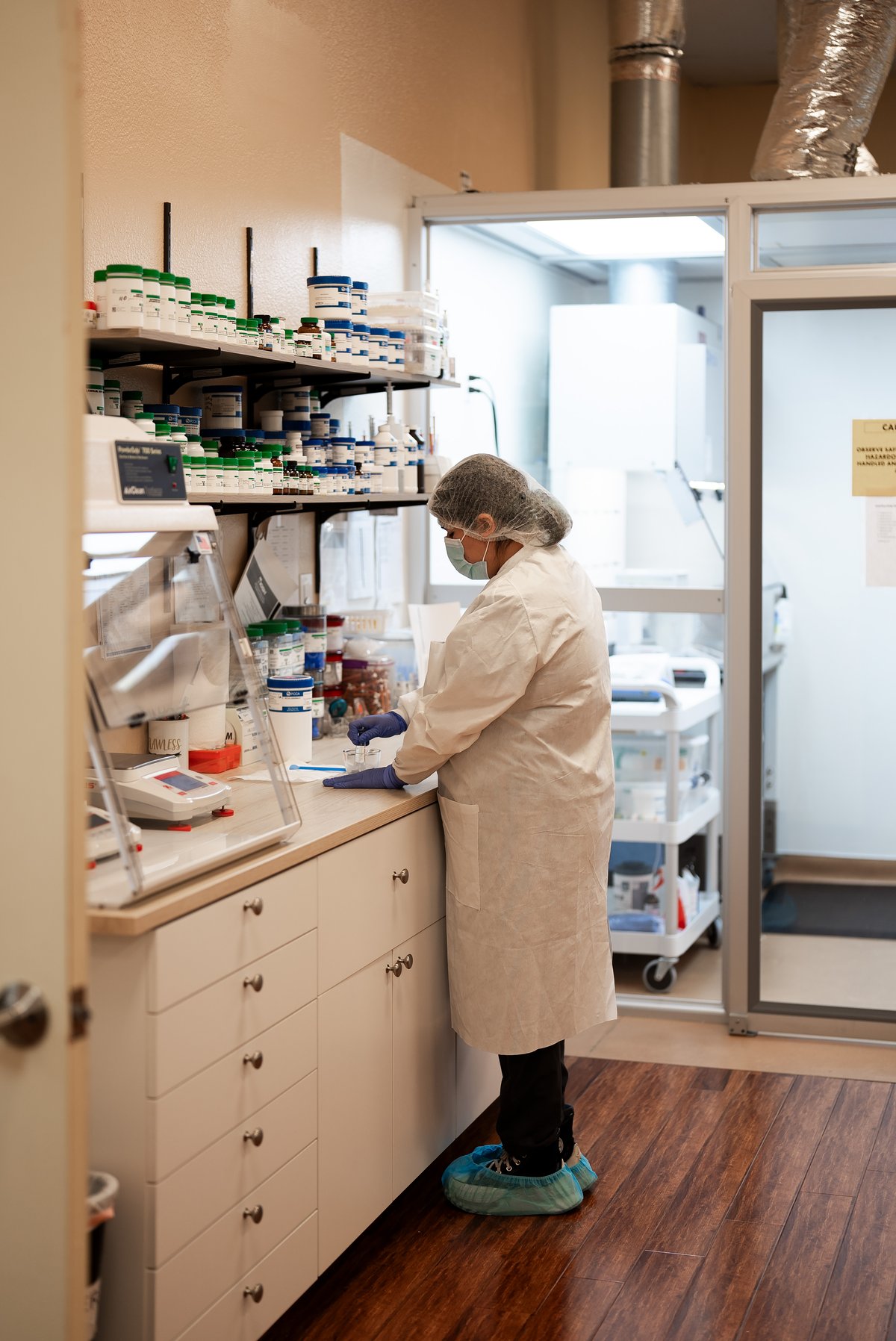
What USP <797> actually covers
USP <797> defines how sterile preparations must be compounded, stored, tested, and dispensed. It applies to injectables, IV admixtures, ophthalmic drops, and other preparations that must remain free of microorganisms. The chapter specifies facility design (cleanrooms and ante-rooms), environmental monitoring, garbing, beyond-use dating, and personnel competency — among other requirements.
TFC prepares sterile compounds under USP <797> in a dedicated cleanroom suite, alongside our USP <795> non-sterile and USP <800> hazardous-drug workflows. For a broader overview of all three chapters, see our USP standards page or Compounding 101.
“USP <797> compliant”
Means the pharmacy follows the chapter’s requirements in policy and practice — documented SOPs, environmental monitoring, garbing, BUD assignment, and competency training. Compliance is an ongoing operational state, not a one-time event.
“USP <797> inspected” (or similar)
Often used loosely in marketing. A state board inspection or accreditation survey may reference USP standards, but the label on a website is not proof. Ask for documentation: environmental monitoring logs, media-fill results, and facility certification records.
What TFC operates under
At a capability level — subject to PIC verification before live publish — our sterile compounding infrastructure includes:
- ISO Class 5 primary engineering control (laminar airflow workbench or equivalent)
- ISO Class 7 buffer room and ISO Class 8 ante-room per USP <797> facility requirements
- Documented garbing, hand hygiene, and personnel training programs
- Routine viable and non-viable air sampling with action limits
- Annual media-fill testing for personnel who compound sterile preparations
- PCAB accreditation covering compounding quality and oversight
503A reminder: Compounded sterile preparations are prepared from individual patient prescriptions and are not FDA-approved drug products. Prescribers remain responsible for clinical appropriateness; the pharmacy is responsible for compounding quality under applicable USP chapters and state law.
Seven questions worth asking any compounding pharmacy
Before you send a sterile Rx
- Do you compound this dosage form and strength in-house, or outsource any step?
- What ISO classification do your buffer room and primary engineering control meet?
- How often do you perform environmental monitoring, and who reviews the results?
- When did your staff last complete media-fill testing?
- How do you assign beyond-use dates — stability data, USP defaults, or both?
- Are hazardous sterile drugs (USP <800>) compounded in a separate containment area?
- Can you provide potency or sterility verification when the prescription requires it?
How this connects to USP <800>
Many sterile compounds — including certain hormones and oncology-supportive preparations — involve NIOSH-listed hazardous drugs. USP <800> adds containment, handling, and cleaning requirements on top of <797>. A pharmacy that claims <797> capability for HD sterile work should also demonstrate <800> containment. Read more on our USP <800> capability page.
Questions about sending a sterile prescription to TFC? Call (323) 348-4205 or visit For Prescribers.